Flipkart — Kubernetes & Chaos Engineering se Big Billion Days ki Reliability
DevOps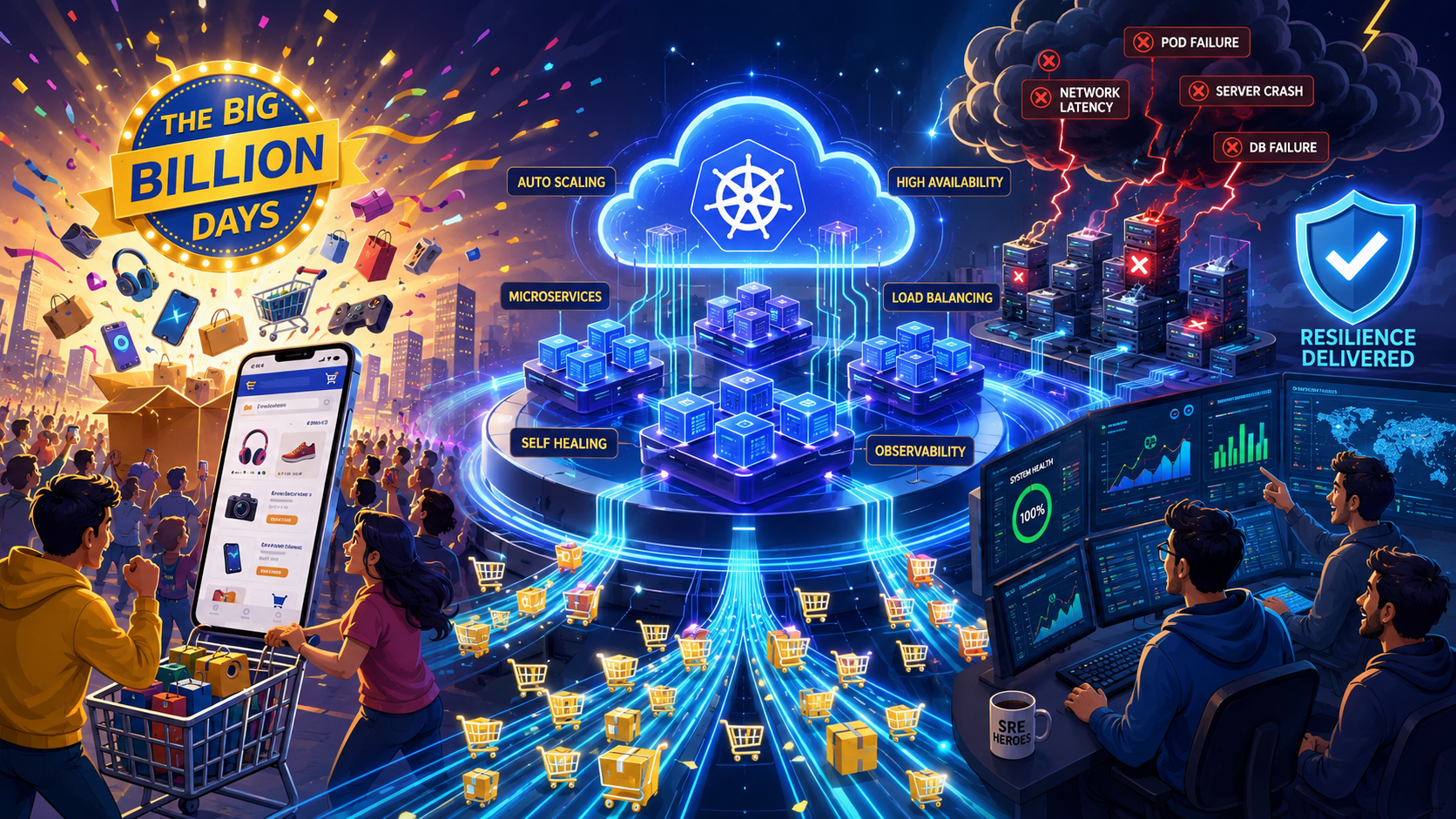
The Challenge
Flipkart, India's largest e-commerce platform serving hundreds of millions of customers, faced an engineering challenge few companies in the world have ever encountered: how do you build infrastructure that can absorb a 20x traffic spike in minutes, recover from unexpected failures instantly, and deploy new features daily — all without a single second of unplanned downtime?
The pressure was most extreme during Big Billion Days, Flipkart's flagship annual sale. In the hours before the sale, traffic would surge from baseline to tens of millions of concurrent users within minutes. A single misconfigured alert, an untested failure scenario, or a slow deployment pipeline could mean millions of dollars in lost revenue and lasting damage to customer trust.
Three core problems were holding the engineering team back:
1. Untested Failure Scenarios
Flipkart's Central Reliability Engineering (CRE) team maintained detailed runbooks describing how to respond to incidents. But these runbooks had a fundamental flaw: the failure scenarios they described had never been exercised under real production conditions. Teams were practicing for a fire drill they had never run. When real failures hit, the runbooks often proved outdated, incomplete, or misaligned with a system that had grown far beyond its original design.
2. Configuration Drift at Scale
With hundreds of microservices across a massive infrastructure, alerting configurations gradually drifted out of sync with reality. Thresholds became outdated. Critical paths went unmonitored. The full extent surfaced during pre-sale prep for Big Billion Days 2024, when the team discovered 6+ critical misconfigurations already live in production alerting — issues that could have caused missed incidents during the most critical hours of the year.
3. Deployment Bottlenecks & Developer Friction
As the platform scaled, shipping a feature meant coordinating across multiple teams, navigating complex manual approvals, and waiting days for infrastructure provisioning. The speed of innovation was being throttled by the very infrastructure meant to enable it.
The Solution
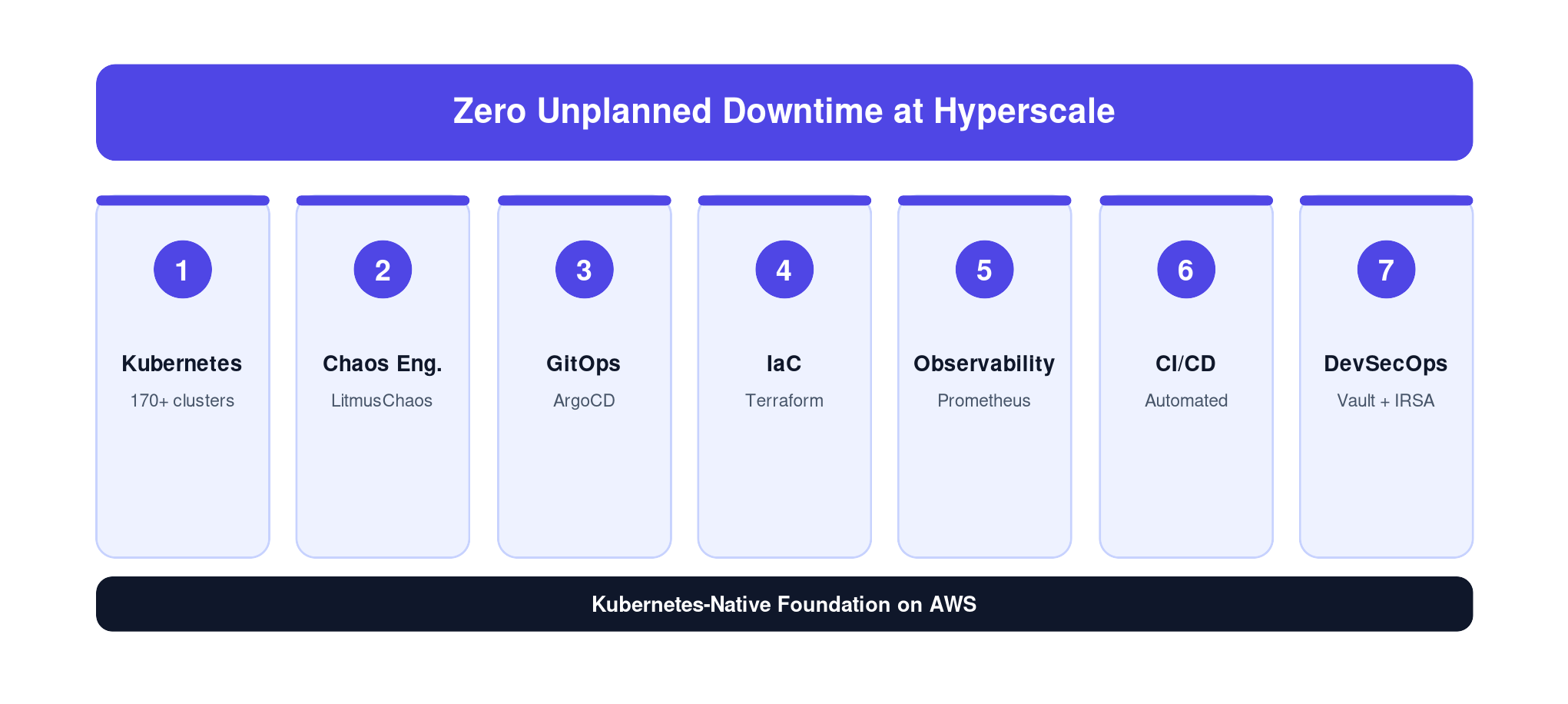
Flipkart's engineering organization responded with a comprehensive DevOps transformation built on seven interconnected pillars — not a single tool adoption, but a fundamental reimagining of how software was built, tested, deployed, and operated at scale.
Pillar 1 — Kubernetes at Hyperscale
Flipkart migrated its entire workload to a Kubernetes-based container orchestration architecture spanning 170+ clusters. Every component became independently deployable, independently scalable, and self-healing by default.
- Multi-cluster strategy — dedicated clusters for production, staging and canary, so pre-production testing never touched live traffic
- Horizontal Pod Autoscaler (HPA) with custom metrics — pods scaled on business signals like orders per second and cart addition rate, not just CPU/memory
- Cluster Autoscaler integrated with AWS EC2 Auto Scaling Groups — node capacity matched demand in minutes, not days
- Custom Resource Definitions (CRDs) to standardize Flipkart-specific deployment patterns
The result: during Big Billion Days, the infrastructure handled 95 million transactions per second at peak.
Pillar 2 — Chaos Engineering with LitmusChaos
Flipkart's most strategically significant investment. Rather than waiting for failures, the CRE team deliberately injected failures under controlled conditions to find weaknesses before customers did — using LitmusChaos, a CNCF-graduated framework, natively in Kubernetes.
- Pod deletion — verifying self-healing and redundancy
- Network latency injection — exposing cascading-failure risks
- CPU/memory stress tests — understanding degradation behavior
- Node failure simulations — confirming workloads migrate correctly
Before Big Billion Days 2024, chaos experiments under production-like load revealed and remediated 6+ critical misconfigurations that conventional testing would never have surfaced.
Pillar 3 — GitOps with ArgoCD
Manual, script-driven deployments were replaced by a fully GitOps model powered by ArgoCD. The old way took two to three days and was highly error-prone.
- Git became the single source of truth for all config and deployments
- ArgoCD continuously reconciled each cluster's actual state with the desired state in Git
- Configuration drift was auto-detected and corrected — manual cluster changes were reverted automatically
- Every change carried a complete, immutable audit trail
Deployment time dropped from days to minutes, and developer autonomy soared.
Pillar 4 — Infrastructure as Code with Terraform
Every AWS component was defined, versioned and provisioned via Terraform.
- Reproducibility — any environment provisioned from scratch in under 20 minutes
- Consistency — no reliance on undocumented manual steps
- Managed services: Amazon EKS, EC2 ASG, RDS Aurora, ElastiCache Redis, S3, CloudFront
- Terraform state in S3 with DynamoDB state locking to prevent concurrent-modification conflicts
Pillar 5 — Full-Stack Observability
Real-time visibility into every layer of the platform:
- Prometheus — metrics from every pod/node/service, including business metrics like checkout conversion and payment success rate
- Grafana — live dashboards for traffic, latency, error rates and health
- ELK Stack — logs from hundreds of microservices in one searchable interface
- Datadog — distributed tracing and APM across dozens of services
- PagerDuty + Alertmanager — intelligent, context-rich alerts with escalation policies
Pillar 6 — Automated CI/CD Pipeline
The pipeline automated the entire journey from commit to production:
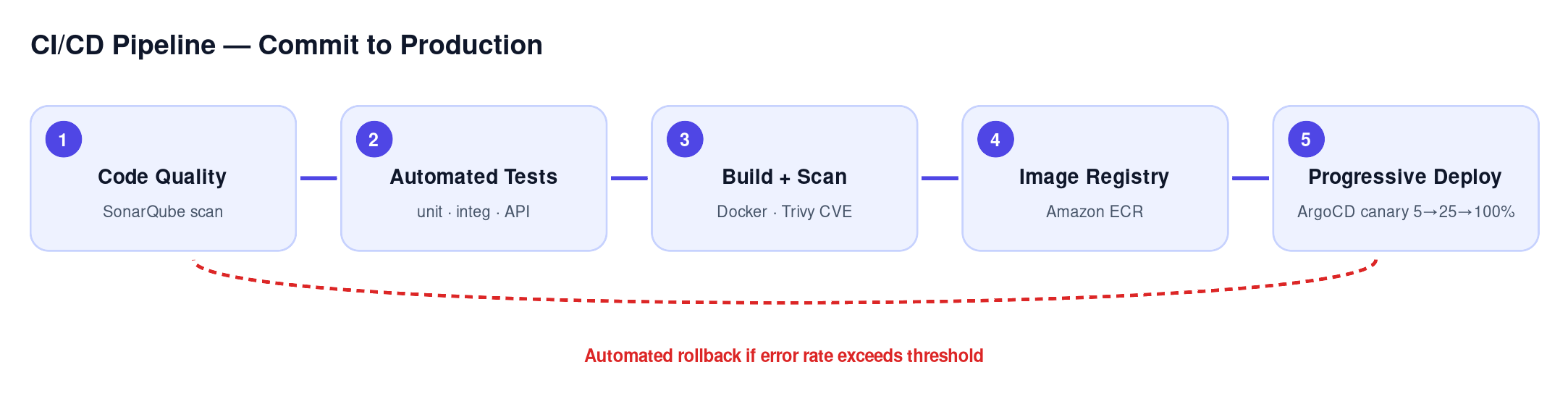
- Code Quality — every commit triggers a SonarQube scan
- Automated Testing — unit, integration and API contract tests run in parallel
- Container Build + Security Scan — Docker images scanned by Trivy for CVEs; failures auto-rejected
- Image Registry — approved images pushed to Amazon ECR with immutable tags tied to the commit SHA
- Progressive Deployment — ArgoCD canary rollout (5% → 25% → 100%) with automated rollback on error spikes
Pillar 7 — DevSecOps Integration
Security was embedded into the workflow, not bolted on afterward:
- HashiCorp Vault managed all secrets — nothing sensitive ever stored in Git or env vars
- AWS IAM Roles for Service Accounts (IRSA) enforced least-privilege access per pod
- Kubernetes Network Policies restricted lateral movement between services
- Automated compliance via AWS Config and CloudTrail — a continuous audit of every API call
The Result
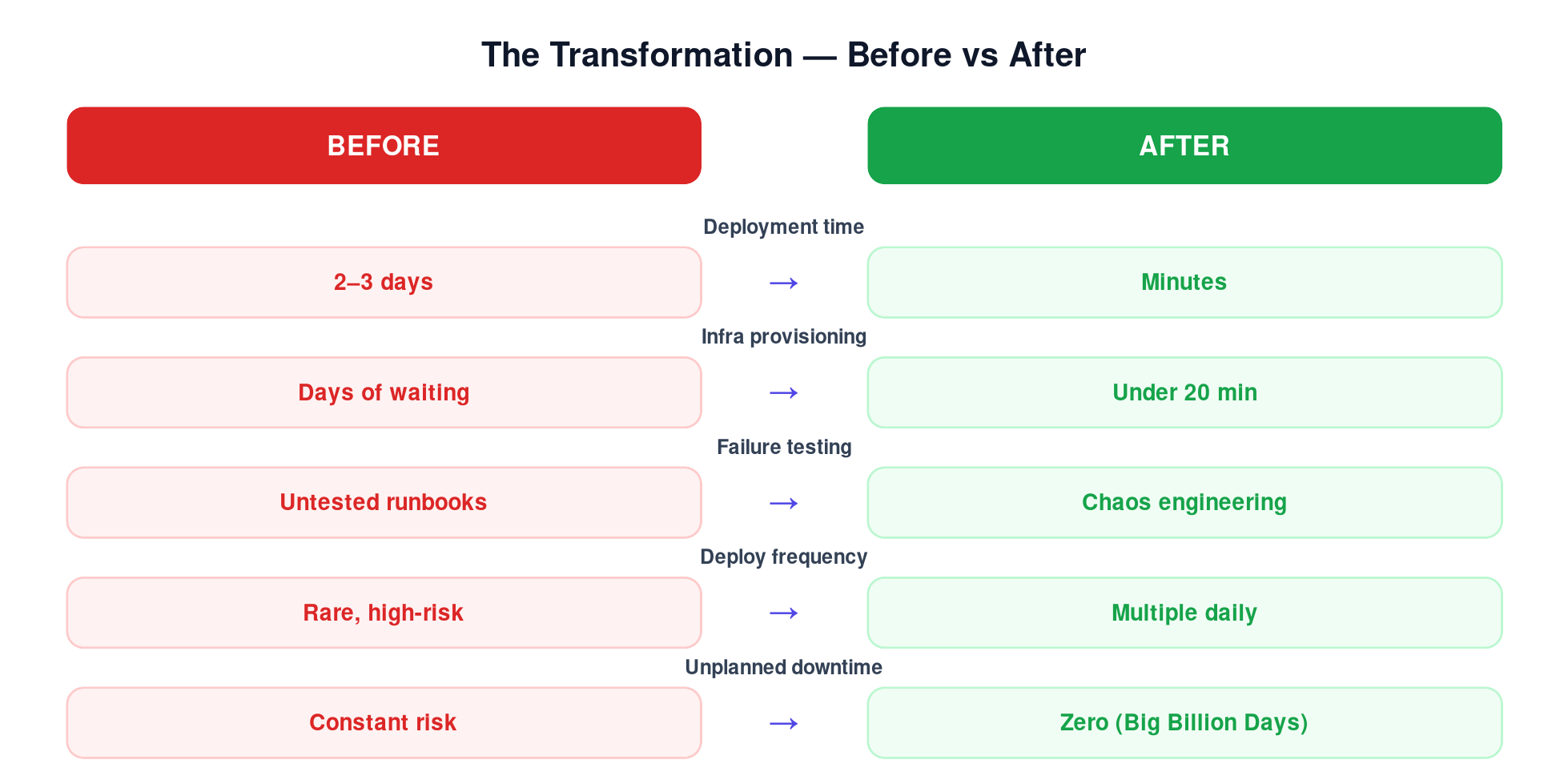
Flipkart's DevOps transformation delivered measurable, industry-leading outcomes across every dimension of engineering performance.
- 95 million transactions per second sustained at peak during Big Billion Days — driven by Kubernetes HPA responding to real-time demand
- 170+ Kubernetes clusters operated and maintained by a lean Central Reliability Engineering team
- 6+ critical production misconfigurations found and fixed before Big Billion Days 2024 — discovered exclusively through chaos engineering
- Infrastructure provisioning cut from days to under 20 minutes via Terraform-based IaC
- Deployment frequency increased dramatically — from rare, high-risk releases to multiple daily deployments across hundreds of services
- Zero unplanned downtime during the highest-traffic, highest-revenue event of the year
- Developer productivity significantly improved through self-service platform engineering
- 🏆 Winner of the CNCF End User Case Study Contest at KubeCon + CloudNativeCon India 2026 — recognized as a reference architecture for Kubernetes-based reliability engineering at scale
Disclaimer: This is an independent technical analysis based on publicly available information from the CNCF official case study, the KubeCon + CloudNativeCon India 2026 keynote, and Flipkart's engineering blog. It is not an official publication of Flipkart or the Cloud Native Computing Foundation.