DevOps Goals & Benefits Explained with Real World Examples (2026)
Understand what DevOps is actually trying to achieve — faster delivery, higher quality, reduced risk, better collaboration, and continuous improvement — with real world examples and a side-by-side comparison with traditional development.
DevOps Goals & Benefits Explained with Real World Examples (2026)
What is DevOps Actually Trying to Achieve?
Most people hear "DevOps" and think it is just a fancy word for deploying code faster. That is part of it — but it is not the whole picture.
DevOps has a much broader goal. It is trying to fix the fundamental way software teams work together. The speed of delivery is a result of fixing that — not the goal itself.
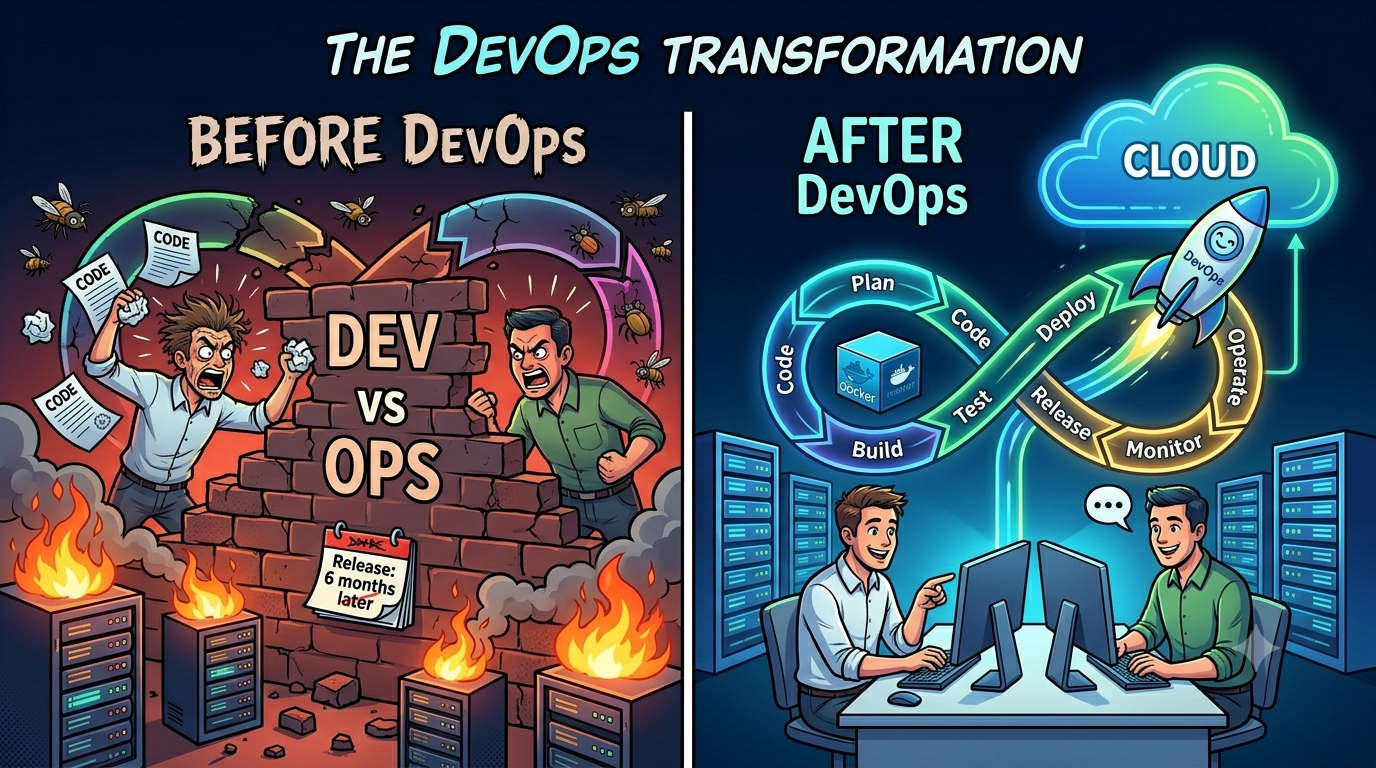
To understand what DevOps is trying to achieve, it helps to first understand what the world looked like before it.
The Problem DevOps Was Built to Solve
In traditional software development, teams followed a model called Waterfall — a slow, sequential process where each phase had to be completed before the next one started. Requirements first, then design, then development, then testing, then deployment. The entire cycle could take six months to a year for a single release.
The problems this created were significant:
- By the time software was released, business requirements had already changed
- Bugs discovered late in the process were expensive and time-consuming to fix
- Developers and operations teams had completely different priorities and almost no communication
- Deployments were stressful, manual, and prone to failure
- There was no way to get fast feedback from real users
DevOps was created as a direct response to these problems. It brings together people, processes, and tools to make software delivery faster, safer, and more collaborative.
The Core Goals of DevOps
DevOps works toward 5 core goals that shape everything teams do:
1. Faster Software Delivery
The primary goal of DevOps is to reduce the time between writing code and getting it into the hands of users. Traditional teams released software every few months. DevOps teams release multiple times a day. This is made possible through automation — automated builds, automated tests, and automated deployments that remove the manual bottlenecks from the delivery process.
2. Higher Software Quality
Speed without quality is useless. DevOps achieves both by embedding testing and quality checks at every stage of the pipeline — not just at the end. Automated tests run on every single commit, which means bugs are caught immediately rather than discovered months later in production.
3. Reduced Deployment Risk
One of the biggest fears in traditional software delivery was the deployment itself. Large, infrequent deployments bundle hundreds of changes together — which means when something goes wrong, tracking down the cause is a nightmare. DevOps solves this by deploying small, frequent changes. If something breaks, it is easy to identify and roll back.
4. Improved Collaboration
DevOps breaks down the wall between development and operations teams. Both teams share responsibility for the product — from writing the first line of code to keeping it running in production. This shared ownership creates better communication, faster problem-solving, and a team culture where everyone is working toward the same outcome.
5. Continuous Improvement
DevOps teams never consider themselves finished. They continuously measure, analyse, and improve — looking for faster build times, more reliable deployments, better monitoring, and smoother processes. The data from production systems feeds directly back into the next cycle of improvements.
The Benefits of DevOps — With Real World Examples
These goals translate into concrete, measurable benefits for any organisation that adopts DevOps properly.
Benefit 1 — Faster Time to Market
Without DevOps: A company takes 3 months to release a new feature, go through manual testing, get approvals, and schedule a deployment window.
With DevOps: The same feature goes through an automated pipeline and is live in production within hours of being written — tested, verified, and deployed automatically.
Real example: Amazon deploys code to production every 11.6 seconds on average. This level of speed is only possible because of mature DevOps practices.
Benefit 2 — Fewer Production Failures
Without DevOps: Bugs make it to production because testing only happens at the end of a long development cycle, and by then there are too many changes to test thoroughly.
With DevOps: Every code commit triggers an automated test suite. Bugs are caught at the point they are introduced — before they ever reach production.
Real example: Companies that adopt DevOps practices report up to 60% fewer production incidents compared to teams using traditional development approaches.
Benefit 3 — Faster Recovery When Things Break
No matter how good your processes are, production systems will occasionally break. The difference with DevOps is how quickly teams recover.
Without DevOps: A production outage means hours of manual investigation, unclear ownership, and a stressful all-hands situation.
With DevOps: Monitoring systems detect the issue immediately, alerts notify the right people, and rollback procedures can restore the previous working version within minutes.
Benefit 4 — Better Security
Traditional security was treated as a final gate — a security review done right before release. This approach consistently failed because by the time security issues were found, fixing them was expensive and time-consuming.
DevOps integrates security into every stage of the pipeline — a practice called DevSecOps. Security scans run automatically on every build. Vulnerabilities are caught early, when they are cheap to fix.
Benefit 5 — Reduced Costs
DevOps reduces costs in several ways:
- Automation eliminates hours of manual work from every deployment
- Catching bugs early is far cheaper than fixing them in production
- Infrastructure as Code allows teams to spin up and tear down environments automatically, eliminating wasted cloud spend
- Faster delivery means companies can respond to market changes before competitors do
DevOps Goals vs Traditional Development — Side by Side
| Area | Traditional Development | DevOps |
|---|---|---|
| Release frequency | Every few months | Multiple times per day |
| Deployment process | Manual, high-risk | Automated, low-risk |
| Testing | At the end of development | Continuous, on every commit |
| Team structure | Dev and Ops work separately | Dev and Ops share responsibility |
| Failure recovery | Hours to days | Minutes |
| Security | Final gate review | Integrated at every stage |
| Infrastructure | Manually configured | Managed as code |
| Feedback | From stakeholders, infrequently | From live systems, continuously |
Who Benefits from DevOps?
DevOps benefits every role in a software organisation — not just engineers.
Developers spend less time dealing with deployment failures and more time building features. Automated pipelines handle the repetitive work.
Operations engineers get clearer processes, better tooling, and shared ownership of the product rather than being the team that "catches" code thrown over a wall.
QA engineers shift from manual, end-of-cycle testing to building automated test suites that run continuously.
Business and product teams get features delivered faster, with more predictable timelines and fewer surprises.
End users get more frequent updates, faster bug fixes, and more reliable software.
Common Misconceptions About DevOps
"DevOps is just automation."
Automation is a tool, not the goal. DevOps is a culture shift that happens to use automation extensively. Teams that buy expensive DevOps tools without changing how they work do not get the benefits.
"DevOps means developers manage servers."
DevOps is about shared responsibility and collaboration — not about forcing developers to do operations work. The roles still exist; the communication and processes between them change.
"DevOps only works for large companies."
The principles of DevOps — automation, collaboration, continuous improvement — benefit teams of any size. A two-person startup and a 50,000-person enterprise both gain from faster, more reliable delivery.
"DevOps is a job title."
DevOps Engineer is a job title, but DevOps itself is a culture and a set of practices that the entire team adopts. Hiring one "DevOps person" and expecting transformation does not work.
Interview Q&A
Q1. What are the main goals of DevOps?
DevOps works toward five core goals: faster software delivery, higher software quality, reduced deployment risk, improved collaboration between development and operations teams, and continuous improvement driven by real production data. These goals work together — automation enables speed, speed enables frequent deployments, frequent deployments reduce risk, and monitoring provides the data needed for continuous improvement.
Q2. What are the key benefits of adopting DevOps?
The key benefits of DevOps include faster time to market through automated pipelines, fewer production failures through continuous testing, faster recovery from incidents through monitoring and automated rollbacks, better security through DevSecOps practices, and reduced costs through automation and Infrastructure as Code. Companies that adopt DevOps consistently report fewer incidents, faster recovery times, and significantly higher deployment frequencies compared to traditional development approaches.
Q3. How does DevOps improve software quality?
DevOps improves quality by moving testing from the end of the development cycle to every stage of it. Automated tests run on every commit, catching bugs at the point they are introduced rather than weeks or months later. This approach — called continuous testing — means that by the time code reaches production, it has already passed hundreds of automated checks. The result is significantly fewer bugs in production and faster resolution when issues do occur.
Q4. What is the difference between DevOps and traditional software development?
Traditional software development uses sequential phases — requirements, design, development, testing, deployment — that can take months to complete. DevOps replaces this with a continuous loop where small changes move through automated pipelines from code to production in hours. Traditional teams have separate development and operations departments with clear handoffs; DevOps teams share ownership across the entire delivery process. Traditional deployments are large, infrequent, and high-risk; DevOps deployments are small, frequent, and low-risk.
Q5. Is DevOps only for large companies?
No. The principles of DevOps — automation, collaboration, continuous feedback, and continuous improvement — benefit organisations of any size. A small startup with a two-person engineering team gains from automated testing and deployment pipelines just as much as a large enterprise does. The tools and scale differ, but the core benefits apply universally. In fact, smaller teams often find it easier to adopt DevOps practices because they have fewer legacy processes to change.
Zero to DevOps Series — Blog 4