Getting Started with DevOps: A Practical Roadmap for Beginners
A beginner-friendly roadmap to learning DevOps — covering the right order to learn Git, Jenkins, Docker, and Kubernetes, and what you'll be able to build by the end.
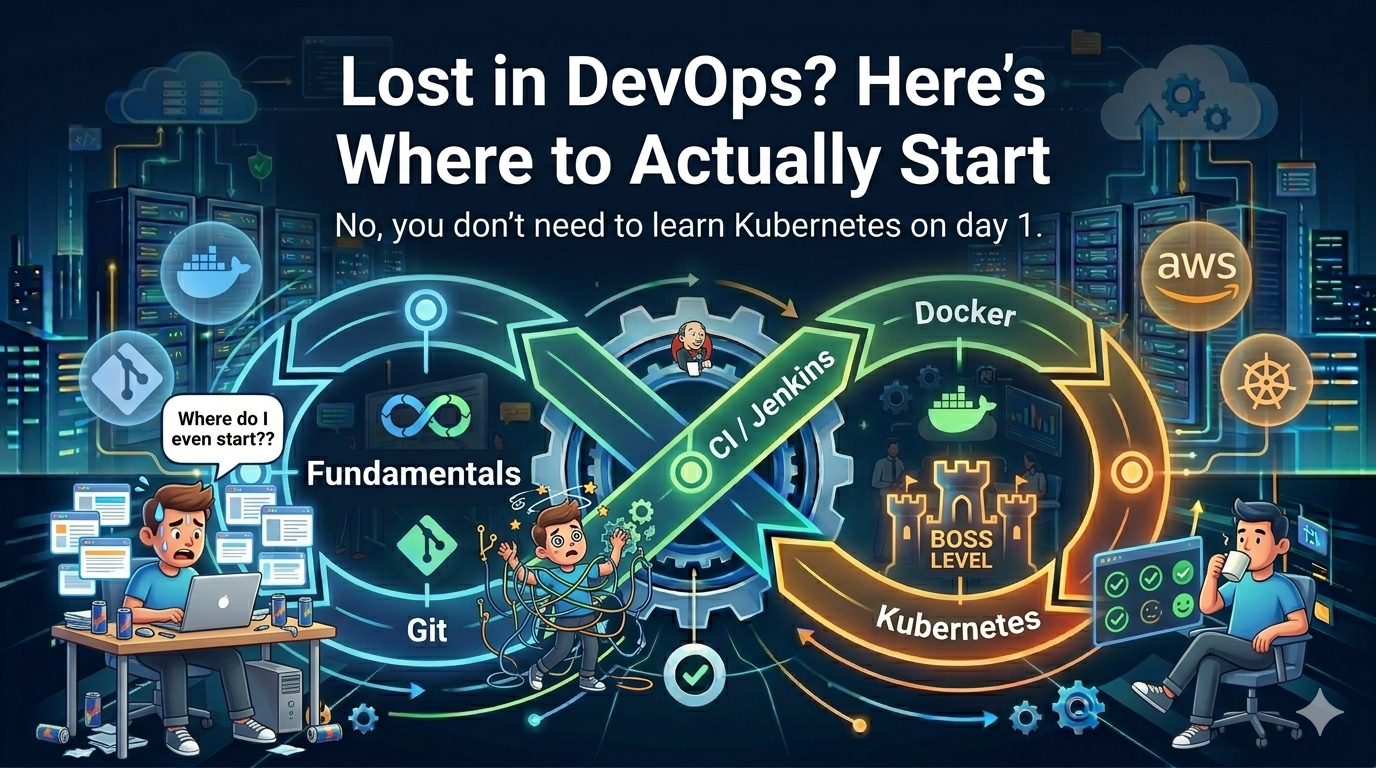
So you've decided to learn DevOps — but where do you actually start? With so many tools (Git, Jenkins, Docker, Kubernetes...) thrown around, it's easy to feel lost before you even begin.
Open up any "Learn DevOps" playlist on YouTube and you'll see the same chaos: Episode 1 is Git, Episode 2 suddenly jumps to Kubernetes, and somewhere in between someone's yelling about Terraform. No order. No story. Just tools thrown at you in random sequence.
If you've felt that confusion — congratulations, you're completely normal. Almost every beginner hits this wall before they even write their first line of CI/CD config.
Here's the good news: DevOps isn't actually random. It's a pipeline — a sequence of stages where each tool solves one specific problem before handing off to the next. Once you see it that way, the "what do I learn first" panic disappears.
Why Most People Learn DevOps the Wrong Way
Here's a pattern you've probably seen: someone gets excited about Docker, learns it in isolation, then gets stuck because they don't understand what happens before Docker (code needs to be tracked and built) or after it (it needs to run somewhere, and someone needs to watch it run).
Tools learned in isolation are just trivia. Tools learned in sequence become a skill.
That's really the whole idea behind this roadmap — not "here are 5 tools," but "here's the order that turns them into one connected system."
The DevOps Learning Path
Think of this like a video game's level progression — you can't skip to the final boss without surviving the earlier levels first.
| Stage | Focus Area | Why It Comes Here |
|---|---|---|
| 1 | DevOps Fundamentals & Lifecycle | You need the "why" before any tool makes sense |
| 2 | Version Control with Git | Every pipeline starts with code sitting in a repo |
| 3 | Continuous Integration & Jenkins | Now that code exists, automate testing and building it |
| 4 | Continuous Deployment & Docker | Package that code so it runs the same everywhere |
| 5 | Kubernetes & Monitoring (Prometheus/Grafana) | Run it at scale, and actually watch what's happening |
Notice the logic: you can't automate testing (stage 3) on code that isn't version-controlled (stage 2). You can't deploy containers (stage 5) before you know how to build one (stage 4). Each stage quietly depends on the one before it.
What You'll Actually Be Able to Do
By the time you've worked through this path, you won't just "know about" DevOps — you'll have hands-on muscle memory for:
- Explaining the DevOps lifecycle and why it replaced siloed dev/ops teams
- Using Git confidently — not just
commitandpush, but branching and merging like a team player - Building a Jenkins pipeline that tests and builds your code automatically, every time you push
- Packaging an application into a Docker container that runs identically on your laptop and in production
- Deploying and scaling that container using Kubernetes
- Watching a live application's health through Prometheus and Grafana dashboards — instead of finding out it's down from an angry user
That last point matters more than people realize. Most beginners learn to build and deploy, then completely skip monitoring — and end up running production systems blind. This roadmap doesn't let you skip it.
This is also the exact skill stack companies are actively hiring for in 2026 — covered in more depth in this breakdown of DevOps career scope.
Interview Q&A
Q1. Do I need to learn these tools in this exact order?
Strongly recommended, yes. Git is the foundation everything else is built on top of — and CI tools like Jenkins only make sense once you understand what they're version-controlling in the first place. Skip to Kubernetes early, and you'll just be memorizing commands you don't understand yet.
Q2. Do I need prior coding experience to start this roadmap?
No. Basic comfort with a command line is enough to begin — the concepts build from zero starting at Stage 1.
Q3. Why is monitoring the last stage instead of being skipped entirely?
Because monitoring something that doesn't exist yet makes no sense. Once you've actually deployed an app (Stage 4-5), monitoring stops being theoretical — it becomes the thing standing between you and a 3 AM panic call when something breaks.
Zero to DevOps Series — Blog 2